

For most Indian businesses, electricity is no longer a predictable monthly expense. It has become
Read MoreA 100 kWh commercial solar battery storage system in Haryana typically costs ₹22–32 lakh installed, with a payback period of 3–6 years depending on load profile, peak-hour consumption, and solar integration.
The cost ranges below are based on industry benchmarks, vendor quotations, and recent commercial solar and storage installations across North India (2025–2026). These estimates are aligned with MNRE guidelines and current market pricing trends.
Costs include battery supply, hybrid inverter, installation, cabling, BMS, and commissioning. Civil works remain site-specific and are quoted separately.
| System Size | Installed Cost | Monthly Saving | Payback | Best For |
|---|---|---|---|---|
| 25 kWh | ₹7–10 lakh | ₹12,000–18,000/mo | 4–6 yr | Small commercial |
| 50 kWh | ₹12–18 lakh | ₹25,000–40,000/mo | 3–5 yr | Medium factory |
| 100 kWh | ₹22–32 lakh | ₹55,000–80,000/mo | 3–4 yr | Large industrial |
| 500 kWh+ | ₹90L–1.5Cr | ₹2.5–4.5 lakh/mo | 2.5–4 yr | Manufacturing plant |
*Actual savings vary based on tariff structure, peak-hour usage, solar generation, and load management strategy.
If your factory or warehouse electricity bill in Haryana crosses ₹50,000 per month, the financial case for a commercial solar battery storage system is often viable, especially when combined with solar generation.
However, the outcome depends on correct system sizing and financial structuring CAPEX purchase, OPEX lease, or hybrid solar financing.
DHBVN and UHBVN – the two DISCOMs serving most of Haryana’s industrial areas enforce Time-of-Day (ToD) tariffs on HT and LT industrial connections. Under the DHBVN Tariff Schedule 2024–25, peak-hour electricity (6 PM–10 PM) costs ₹9–12 per unit. Solar hours cost ₹5–7. That gap ₹4–7 per unit is money you are currently paying to the grid every single day.
A battery storage system charges during solar generation hours and discharges during peak tariff hours. For a factory consuming 200 units during peak hours daily, the saving from tariff arbitrage alone is ₹24,000–42,000 per month.
Add diesel genset displacement (₹18–22 per unit vs. ₹0 from battery backup), demand charge reduction, and improved solar self-consumption and the financial model becomes hard to argue against.
Sun Photonics is a registered commercial solar installer in Haryana with a track record of completed industrial solar projects across the state. Our team handles everything from initial energy audit to DISCOM net metering approval, commissioning, and long-term AMC.
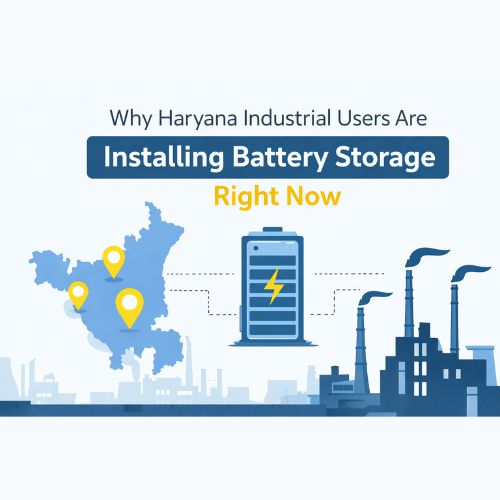
1. Peak-Hour Tariff Arbitrage
DHBVN and HVPNL peak tariffs typically range between ₹9–12 per unit, while off-peak and solar-hour rates fall in the ₹5–7 per unit range.
By shifting ~200 units per day from peak to solar hours, industrial users can achieve estimated savings of ₹24,000–42,000 per month, depending on load profile and tariff category.
2. Grid Backup Without a Diesel Generator
A 100 kWh LFP battery can support approximately 15–20 kW of essential loads for 4–5 hours during a grid outage, with near-instant switchover.
Diesel genset generation costs typically range from ₹18–22 per unit, while battery backup operates at a significantly lower marginal cost after payback.
In many cases, partial cost recovery compared to diesel backup can occur within 2–4 years, depending on outage frequency and usage.
3. Solar Self-Consumption: From ~55% to 75–85%
A grid-tied solar system without storage often exports 30–45% of generated energy back to the DISCOM at buyback rates of ₹2–4 per unit, which is significantly lower than import tariffs.
Battery storage helps utilize this surplus internally, increasing self-consumption to ~75–85% in well-optimized systems.
This is particularly relevant in Haryana, where export approvals and net metering limits can impact project efficiency.
4. Demand Charge Reduction
Industrial tariffs under DHBVN and HVPNL include demand charges based on contracted kVA.
A properly sized BESS can reduce peak demand spikes, potentially lowering contracted demand by 5–15%, depending on load behavior.
For large industrial consumers, this can translate to ₹10,000–80,000 per month in savings.
5. BRSR and ESG Compliance
SEBI’s BRSR framework, mandatory for the top 1000 listed companies from FY2023, requires disclosure of renewable energy usage and sustainability metrics.
Battery-integrated solar systems provide more consistent renewable energy utilization and measurable data, supporting ESG reporting and compliance requirements.
40% Accelerated Depreciation — Year 1
All commercial and industrial solar and BESS assets qualify under the Income Tax Act Section 32. For a company in the 25% tax bracket, installing a ₹50 lakh system, this is approximately ₹5 lakh in tax savings in Year 1 reducing net investment by 10%.
MNRE Viability Gap Funding (VGF)
Available for BESS projects above 1 MWh, contracted through DISCOM or a state nodal agency, and meeting MNRE technical specifications. Sun Photonics is MNRE-empanelled and handles VGF documentation as part of our energy storage system project delivery.
IREDA and SIDBI Green Energy Loans
IREDA offers project financing at 10.5–11.5% per annum for BESS projects. SIDBI’s SPEED scheme covers MSMEs specifically. Combined with Year-1 accelerated depreciation, the effective net investment is significantly lower than the headline capex number.
PLI for Advanced Chemistry Cell Batteries
The ₹18,100 crore PLI scheme is scaling domestic LFP and NMC battery manufacturing in India. Battery costs are projected to fall 30–40% by 2027 compared to current import-based pricing.
Rooftop solar subsidy under PM Surya Ghar (up to ₹78,000) is applicable only for residential connections and does not apply to industrial or commercial electricity connections.
For factories and warehouses, financial benefits typically come from:
If a solar installer claims residential subsidy benefits for an industrial connection, verify the exact scheme details and official notification before proceeding.

LFP (Lithium Iron Phosphate) is the correct choice for industrial use in Haryana. Here’s why the alternatives don’t hold up in Indian conditions:
| Battery Type | Cycle Life | Cost/kWh | Heat Tolerance | Verdict for Haryana |
|---|---|---|---|---|
| LFP | 3,000–6,000 | ₹18,000–28,000 | Up to 60°C | ✓ Best — heat-stable, safest, lowest cost per cycle |
| NMC | 1,500–3,000 | ₹22,000–35,000 | Up to 45°C | ✗ Degrades above 40°C — Haryana summers exceed this |
| VRLA Lead-Acid | 300–800 | ₹8,000–12,000 | Up to 40°C | ✗ Cheapest upfront, highest lifetime cost — avoid for daily cycling |
| Vanadium Flow | 10,000+ | ₹40,000–60,000 | Wide range | Only viable above 500 kWh — not cost-effective for most factories |
Battery rooms in Haryana regularly hit 42–48°C ambient in May–June. NMC degrades measurably and irreversibly above 40°C. LFP is thermally stable to 60°C with no thermal runaway risk. For any industrial solar EPC company in Haryana that recommends NMC for a factory application, ask them for a written performance warranty at 45°C ambient. They will not provide one.
1. Upfront Capital — Structure It Correctly
A 50 kWh system is ₹12–18 lakh. A 100 kWh system is ₹22–32 lakh. These are not small commitments. IREDA loans at 10.5–11.5% p.a., combined with Year-1 accelerated depreciation, make the net effective investment significantly lower, but your CFO needs to model this before the LOI, not after. Sun Photonics provides a detailed 15-year financial model before you commit to anything.
If upfront capital is a constraint, ask us about our OPEX solar model, where you pay per unit consumed, with zero capital outlay.
→ See our OPEX Model for Commercial Solar Installations
2. Battery Degradation — Build It Into Your Model
An LFP system starting at 100 kWh delivers approximately 80 kWh after 3,000 cycles, roughly 8–10 years of daily cycling. Battery replacement costs are projected to fall 35–45% from current levels by 2030. Factor replacement into your 15-year financial model.
3. Space and Civil Requirements
A 100 kWh rack-mounted LFP system needs 4–6 sq. m. with 600mm clearance on all sides. Systems above 500 kWh require a dedicated battery room with fire suppression, thermal management, and signage per CERC draft BESS safety guidelines (2023). Confirm your site layout before sizing.
4. AMC Is Non-Negotiable
Annual BMS software updates, terminal torque checks, and capacity tests are required to maintain the warranty. Skipping maintenance voids warranties and shortens battery life. Budget ₹15,000–50,000 per year, depending on system size.
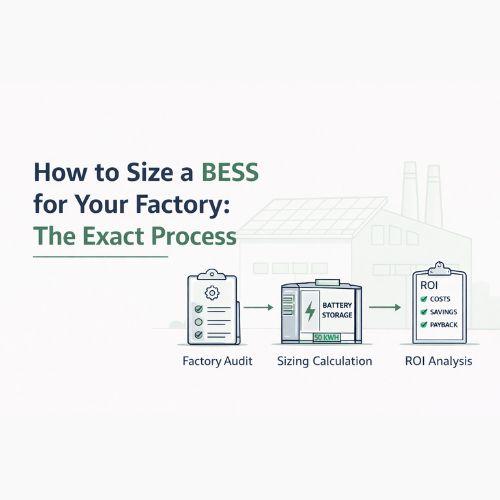
Most buyers make expensive mistakes here, either undersizing (objectives not met) or oversizing (capital wasted). Here is the correct process:
1. Pull 12 months of electricity bills. Calculate average monthly consumption (kWh), peak demand (kVA), and what percentage of consumption falls in peak tariff hours.
2. List every piece of equipment you need during a grid outage and its power draw in kW. Essential loads only.
3. Apply the formula: Battery (kWh) = Essential load (kW) × Required backup hours ÷ 0.90. Example: 15 kW × 4 hours ÷ 0.90 = 66.7 kWh, minimum round up to 75 kWh standard size.
4. Check solar-battery balance. Your battery should store 1–1.5 days of excess solar generation. Oversizing beyond this gives diminishing returns.
5. Run the 15-year financial model: capex, opex (AMC), annual energy saving, tariff escalation at 3–5% per year, and battery replacement at year 10–12.
Sun Photonics provides this sizing and feasibility analysis at no cost, with no obligation, within 5 working days of receiving your last three electricity bills.
A poorly executed commercial solar installation can underperform by 20–30%, and you won’t know it for 12–18 months. Five things to verify before you sign:
Sun Photonics operates with in-house installation teams across Haryana. All projects are delivered under a single EPC contract — design, supply, installation, DISCOM approval, and commissioning.
Jatin Singh is a content developer at Sun Photonics Pvt. Ltd., specializing in creating impactful content for solar energy solutions. With a background in tech and health, he has previously worked in digital marketing and pharma. Passionate about sustainability, and currently exploring all things about solar!
Approval by an Expert:
“This content is reviewed and approved by Dr. Sujata Bhaker, who holds a Doctorate in Renewable Energy and brings over 10 years of industry expertise.”

For most Indian businesses, electricity is no longer a predictable monthly expense. It has become
Read More
Winters expose every weakness in a rooftop solar system — moisture, fog, temperature swings, metal
Read More
As India accelerates its path toward clean and sustainable green energy, the role of Solar
Read More
India’s energy sector is transforming rapidly, and commercial rooftop solar has emerged as a core
Read More
Introduction: Why BIPV Is Gaining Traction in India (2026 Update)Cities are growing taller, streets are
Read MoreA 50 kWh system costs ₹12–18 lakh, while a 100 kWh system costs ₹22–32 lakh (excluding civil works). Net investment can reduce by 8–10% with accelerated depreciation.
No. PM Surya Ghar subsidy is only for residential users. Industrial projects benefit from accelerated depreciation, select MNRE programs, and green energy financing.
Typical payback is 3–6 years, depending on usage, tariffs, and system size. Savings vary based on peak-hour consumption and solar integration.
Yes. A BESS switches in 20–40 ms, ensuring uninterrupted power. A 100 kWh system can support essential loads for 4–5 hours.
Process includes: