

For most Indian businesses, electricity is no longer a predictable monthly expense. It has become
Read MoreRead our quick GEOA guide already? Cool. But this one’s built for people who need more than just headlines.
This full 2025 guide dives deeper. Here you can learn about :
✅What is Green Energy Open Access?
✅Why is Open Access Good for your Businesses?
✅Types of Green Energy Open Access in India
✅Duration of Green Energy Open Access in India
✅Who Can Apply for Green Energy Open Access?
✅How to apply for green energy open access in India
and many more things
Whether you’re planning your first move into Open Access or trying to optimize what you’ve got, this guide gives you clarity, not confusion.
No fluff. Just the stuff that matters.
Electricity costs are rising, and every business owner is feeling the pressure to find cheap solar power for their business without getting stuck in heavy upfront investments. That’s where Green Energy Open Access comes in — a new and smarter way to power your commercial or industrial operations. Instead of spending capital on installing a plant, you switch to solar energy on lease through the GEOA model, reduce your power bills, and still meet sustainability and compliance goals.
At Sun Photonics, we help Indian businesses make this shift smoothly so they can control electricity expenses, avoid high initial costs, and move toward a more stable, future-ready energy strategy. It’s not just about going green — it’s about running your business more intelligently.
Below, you can see the step-by-step process to adopt GEOA for your business.
Green Energy Open Access is a government-approved framework that allows commercial and industrial (C&I) consumers to purchase renewable energy, mainly solar and wind, directly from power producers, bypassing local DISCOMs (Distribution Companies).
This means businesses can get cheaper, cleaner energy from independent solar power developers like Sun Photonics, without setting up a solar plant at their own site.
In simple terms, it’s like buying solar electricity in bulk, directly from a solar farm, under a long-term agreement.
Because you’re free to choose your energy supplier. No more being tied down by expensive electricity rates from local power companies. The green energy flows to your unit through the existing grid under a power purchase agreement (PPA).
You’re running a manufacturing unit, factory, or commercial facility, and to keep operations at full capacity, you need reliable power all the time. But reliable power usually comes with a painful side effect: massive electricity bills, pressure on your financials, and extra load on generators during outages. Most businesses start looking for cheap solar power for my business, but the challenge is finding a solution that actually works without a huge upfront investment. That’s exactly where Green Energy Open Access, introduced by the government, changes the game. It gives factories access to clean, predictable-cost energy without owning the infrastructure.
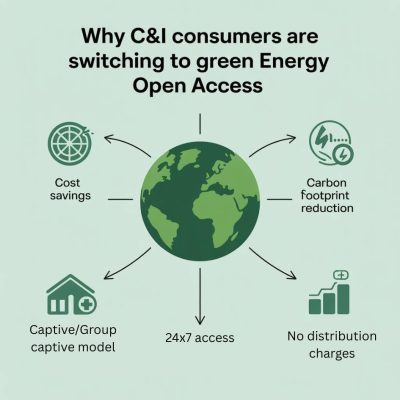
Open access solar power costs 30–50% less than conventional grid power. That means massive savings for your manufacturing plant or commercial facility every month.
With the open access model, you don’t need to invest in rooftop panels or land. Sun Photonics sets up and manages the solar infrastructure—you only pay for the electricity.
Since the solar plant is located remotely and maintained by professionals like us, you never have to deal with breakdowns or cleaning. It’s a plug-and-play solution.
Many B2B clients today prefer working with eco-conscious companies. Switching to green energy for factories enhances your ESG score and gives you a competitive edge.
As your operations grow, your energy requirement increases. Open access is scalable—you can expand your energy capacity without changing your setup.
You get renewable energy certificates (RECs) or carbon credits that can help in compliance or trading.
In short, open access isn’t just a power decision—it’s a smart business decision.
Depending on your business model and energy strategy, there are several options under Open Access Solar Policy India:
a) Captive Open Access Solar
In this model, your company holds at least 26% ownership in the solar power plant and consumes at least 51% of the power generated. It gives you the lowest cost of electricity in the long run.
Ideal for: Large manufacturing plants or industrial estates.
b) Third-Party Open Access
Here, you simply sign a PPA with a solar power developer like Sun Photonics, and the electricity is billed monthly. No ownership, no CAPEX.
Ideal for: Warehouses, commercial buildings, malls, cold storage units, etc.
c) Group Captive
If multiple businesses come together to invest in a solar project, they can share the energy output.
Ideal for: Clusters of SMEs and industrial parks.
The right model, design the agreement, and ensure smooth power delivery. We are with you.
If you’re unsure about the profitability of using the Open Access process, consider starting with a short-term agreement to evaluate its benefits firsthand.
Any commercial or industrial consumer with a connected load of 100 kW or more is eligible under the new Green Energy Open Access 2022 Rules.
This includes:
Whether you’re based in Gurgaon, Hisar, Bhiwadi, Bawal, Faridabad or any other part of Haryana—Sun Photonics can help you to go green under the open access mechanism.
The process might seem complex at first, but with the right guidance and support, it quickly becomes clear and manageable.
Step-by-step process:
We manage everything—from paperwork to coordination with DISCOMs and regulatory bodies.
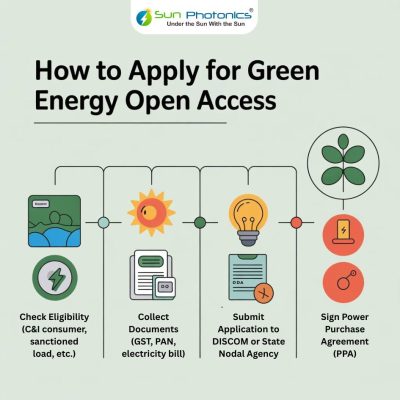
The exact requirements may different according to state-to-state, but we give you a general checklist for applying under Green Energy Open Access Solar in Haryana or other regions. Most applications today are submitted through the GOAR (Green Open Access Registry) portal, as mandated by the Ministry of Power for transparency and faster processing.
General Documents Required:
We offer complete end-to-end documentation support, including guidance on uploading and submitting through the GOAR portal, so your application doesn’t face unnecessary delays or rejections. Still, it’s important to ensure your documents are accurate and up to date to save time and avoid back-and-forth with authorities.
Green Energy Open Access can offer lower power costs, but you’ll still need to pay some charges either one-time or recurring based on CERC/SERC regulations.

The Electricity (Promoting Renewable Energy Through Green Energy Open Access) Rules, 2022 brought major reforms in India’s solar landscape.
Here’s what changed:
Previously, open access was only for consumers with 1 MW+ load. Now, it’s available to any consumer with 100 kW+ load—opening doors for more SMEs and MSMEs.
The approval timeline is now capped at 15 days for most cases. No more bureaucratic delays.
States must now follow a uniform formula for wheeling and banking charges. This removes hidden costs and unpredictability.
A single-window portal must be provided by every state to handle open access applications and status tracking.
These rules are a game-changer for industries looking to shift toward industrial solar open access in a transparent and efficient manner.
We don’t just install solar. We build green energy partnerships.
Whether you need captive open access solar, want to explore the Open Access Solar Policy India, or simply want to lower your energy bill, we’ve got you covered.
Conclusion: A Future You Can’t Afford to Miss
The future of industrial energy is not coal, diesel, or expensive grid power—it’s solar, and it’s open access.
Green energy open access gives your business the freedom to grow sustainably, save massively, and stand tall in a green economy.
Jatin Singh is a content developer at Sun Photonics Pvt. Ltd., specializing in creating impactful content for solar energy solutions. With a background in tech and health, he has previously worked in digital marketing and pharma. Passionate about sustainability, and currently exploring all things about solar!
Approval by an Expert:
“This content is reviewed and approved by Dr. Sujata Bhaker, who holds a Doctorate in Renewable Energy and brings over 10 years of industry expertise.”
It’s a government-approved system that lets businesses buy solar or wind power directly from developers, bypassing DISCOMs.
It cuts electricity costs by 30–50%, requires no CAPEX, has zero maintenance, and boosts your sustainability image.
Any C&I consumer with a connected load of 100 kW or more.
Assess load → Choose model → Sign PPA → Get approvals → Connect to grid → Start receiving green power.
You pay for transmission, wheeling, CSS (if third-party), banking, LDC fees, and DSM penalties (if applicable).
Lowered eligibility to 100 kW, 15-day approval time, standard charges, and mandatory online portals for all states.
For most Indian businesses, electricity is no longer a predictable monthly expense. It has become
Read More
Winters expose every weakness in a rooftop solar system — moisture, fog, temperature swings, metal
Read More
As India accelerates its path toward clean and sustainable green energy, the role of Solar
Read More
India’s energy sector is transforming rapidly, and commercial rooftop solar has emerged as a core
Read More
Introduction: Why BIPV Is Gaining Traction in India (2026 Update)Cities are growing taller, streets are
Read More